How BDI-Kit Works
The library is designed around a human-in-the-loop workflow. Instead of treating harmonization as a fully automatic process, BDI-Kit allows users to inspect intermediate results, review suggested matches, and refine mappings before generating the final harmonized dataset.
Overview
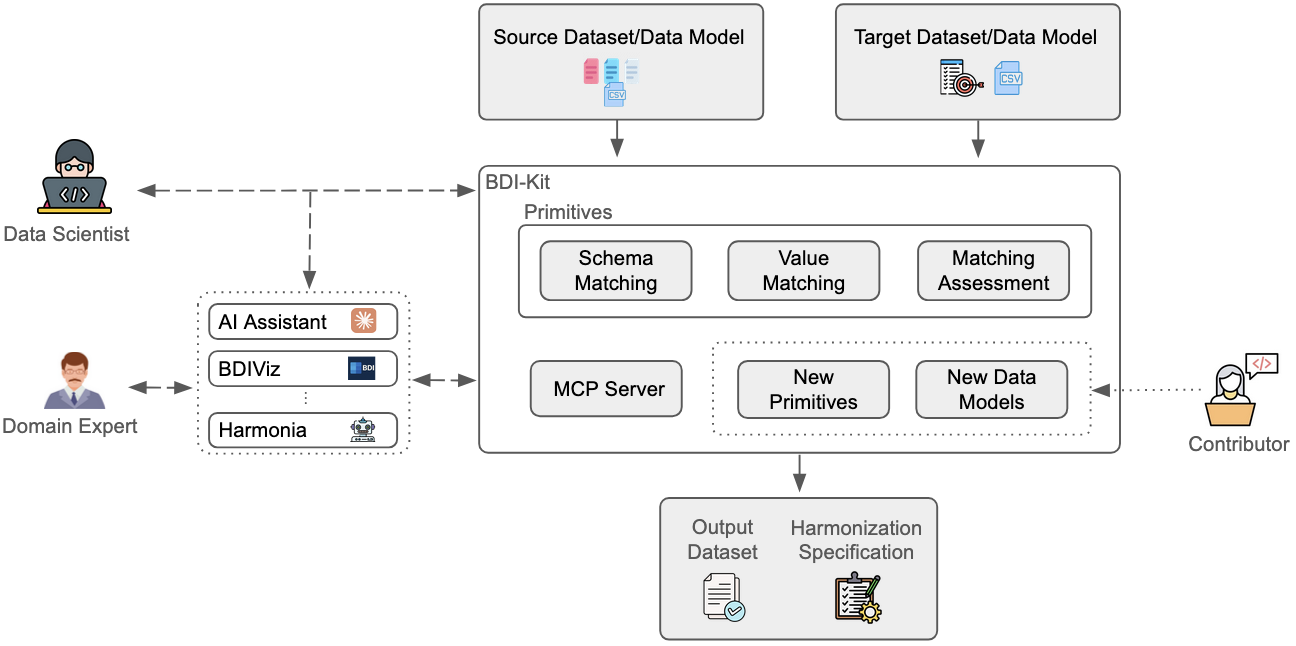
Below is an overview of the BDI-Kit harmonization workflow.
Inputs
A harmonization task consists of a source and a target, where each can be either a dataset represented as a pandas DataFrame or a data model. Data models include metadata such as attribute names and descriptions, allowing BDI-Kit to support different standards and schemas.
Harmonization Primitives
BDI-Kit provides composable primitives that can be combined into custom workflows.
Schema Matching
Schema matching identifies relationships between attributes/columns in the source and target datasets. For example, BDI-Kit can suggest that:
patient_agematchesage_at_diagnosissexmatchesgender
Each match includes similarity scores so users can inspect alternative candidates and resolve ambiguous cases.
Value Matching
After attributes/columns are matched, value matching aligns the values inside those attributes/columns. For example:
"Male"→"M""Stage II"→"2"
BDI-Kit supports multiple value matching strategies, including textual similarity, embedding-based methods, and numeric transformations.
Match Assessment
BDI-Kit also provides tools to assess and explain matches. These explanations help users understand why a match was proposed and identify potentially incorrect mappings before applying transformations.
Harmonization Specification
The result of the harmonization process is:
A harmonized dataset
A harmonization specification
The harmonization specification stores the transformations and mappings used during harmonization, making the process transparent and reproducible. Specifications can also be reused on new datasets with similar schemas, reducing the need to repeat the same harmonization steps.
Interaction Options
BDI-Kit supports two ways of interacting with the system.
Python API: Users can directly call harmonization functions from Python and integrate them into data pipelines and notebooks.
AI-Assisted Interface: In this mode, AI assistants can help orchestrate harmonization tasks using natural language while users remain in control of accepting or refining suggestions.
Extensibility
BDI-Kit is designed to be extensible. Developers can:
Add new schema matching algorithms
Add new value matching methods
Support additional data models
Integrate BDI-Kit into external AI systems and workflows
This modular design allows the toolkit to evolve alongside new harmonization methods and domain requirements.